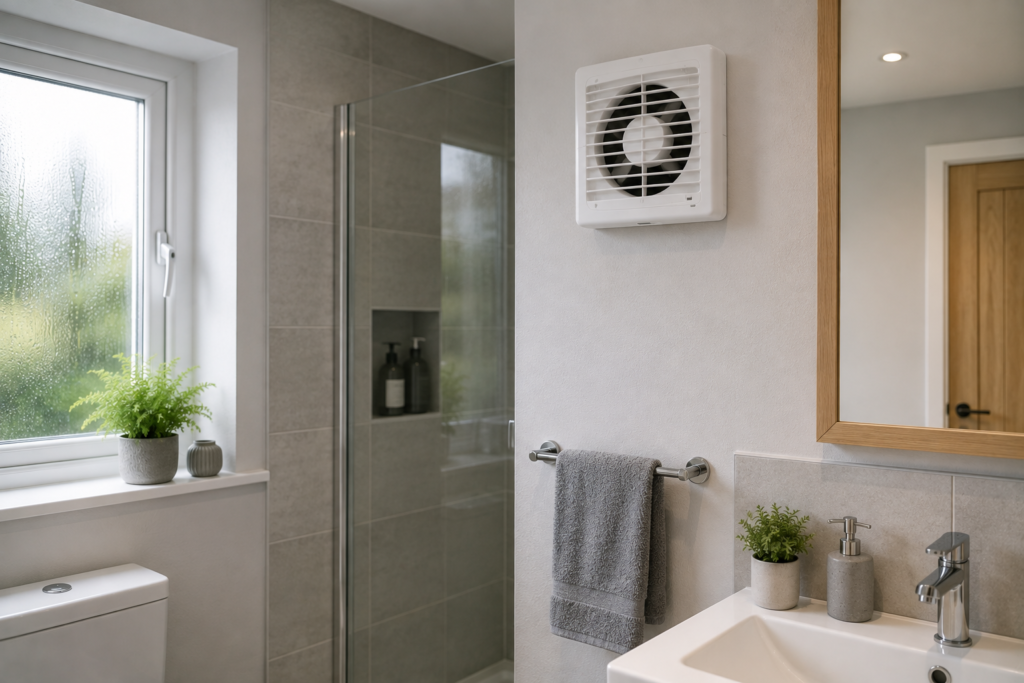
If your bathroom regularly steams up and stays damp long after showers, ventilation is not optional — it’s essential.
An effective extractor fan removes moist air before it settles on ceilings, walls, and sealant. Without proper extraction, condensation forms repeatedly, leading to mould, peeling paint, and ongoing cleaning cycles.
If your ceiling keeps going mouldy, read Why Your Bathroom Ceiling Gets Mouldy (And How to Stop It).
If you’re also seeing condensation on windows, see How to Stop Condensation on Windows to understand the wider humidity issue.
This guide explains the main types of bathroom extractor fans available in the UK, what performance actually matters, and how to choose one that solves the problem properly.
Why ventilation matters more than people think
Bathrooms generate large volumes of moisture in a short time.
Hot showers produce steam that rises and collects on:
- Ceilings
- Upper corners of external walls
- Cold tiles
- Sealant joints
If that moisture is not extracted quickly enough, it remains long enough for mould spores to grow.
Many bathrooms technically have a fan — but it’s either:
- Underpowered
- Poorly ducted
- Turned off too soon
- Not left running long enough
Ventilation is about air change rate, not just noise and appearance.
UK building regulation minimum (important)
In the UK, Building Regulations generally require:
- 15 litres per second (l/s) extraction rate for bathrooms without windows
- 15 l/s intermittent extract minimum
- 8 l/s continuous extract (for continuous systems)
If your fan is weaker than this, mould problems often persist.
This is why simply “having a fan” is not enough.
Types of Bathroom Ventilation Fans
Axial Fans
Best for:
- Small bathrooms
- Short duct runs (straight through an external wall)
Pros:
- Affordable
- Often quieter
- Simple installation
Cons:
- Can struggle with long ducting
- Less effective through loft runs
Centrifugal Fans
Best for:
- Longer duct runs
- Venting through loft spaces
- Persistent moisture problems
Pros:
- More powerful
- Better performance over distance
- Stronger extraction consistency
Cons:
- Usually more expensive
- Slightly louder depending on model
For bathrooms where mould repeatedly returns, centrifugal fans are often the safer choice.
Humidity-Sensing (Humidistat) Fans
Switch on automatically when moisture levels rise.
Best for:
- Busy households
- Families who forget to run the fan
- Reducing reliance on manual switching
They help prevent the common mistake of turning the fan off too soon.
Timer (Run-On) Fans
Continue running for a set time after the light is turned off.
Best for:
- Standard UK bathrooms
- Preventing “fan off too soon” problems
A run-on timer of 15–20 minutes significantly improves drying performance.
Comparison Overview
(Insert your existing comparison table here.)
What size fan do you actually need?
Choosing the right fan is about matching extraction rate to room size.
As a general rule:
- Small bathroom (toilet or ensuite): 15 l/s minimum
- Medium bathroom with shower: 15–21 l/s
- Larger bathrooms: 21+ l/s recommended
If mould keeps returning despite fan use, upgrading extraction strength is often more effective than cleaning products.
What to look for
- Extraction rate clearly stated (in litres per second or m³/hour)
- Timer or humidity sensor option
- Suitable IP rating for bathroom zones
- Clear UK electrical compliance
- Noise level in decibels (dB)
Noise matters — overly loud fans get turned off early.
What to avoid
- Underpowered fans for steamy bathrooms
- Fans without timers in windowless rooms
- Long duct runs with axial-only units
- Venting into loft space without proper external ducting
Incorrect ducting can worsen condensation and even create roof space moisture issues.
When ventilation alone may not solve the issue
Extractor fans address steam at source — but if humidity remains high throughout the home, mould may still appear.
If condensation forms on windows in multiple rooms, see:
Ventilation and humidity control work together.
Who this is suitable for
- Bathrooms with recurring ceiling mould
- Steam lingering long after showers
- Windowless bathrooms
- Homes with multiple daily showers
Who may not need replacement
- Bathrooms that dry quickly already
- Mould caused by plumbing leaks
- Properties with whole-house ventilation systems
Final thoughts
A good extractor fan doesn’t just reduce mould — it changes how moisture behaves in your home.
When properly sized and used correctly, it:
- Shortens drying time
- Protects ceilings and paint
- Extends sealant lifespan
- Reduces long-term maintenance
If cleaning feels like a cycle that never ends, improving ventilation is often the turning point.