Introduction
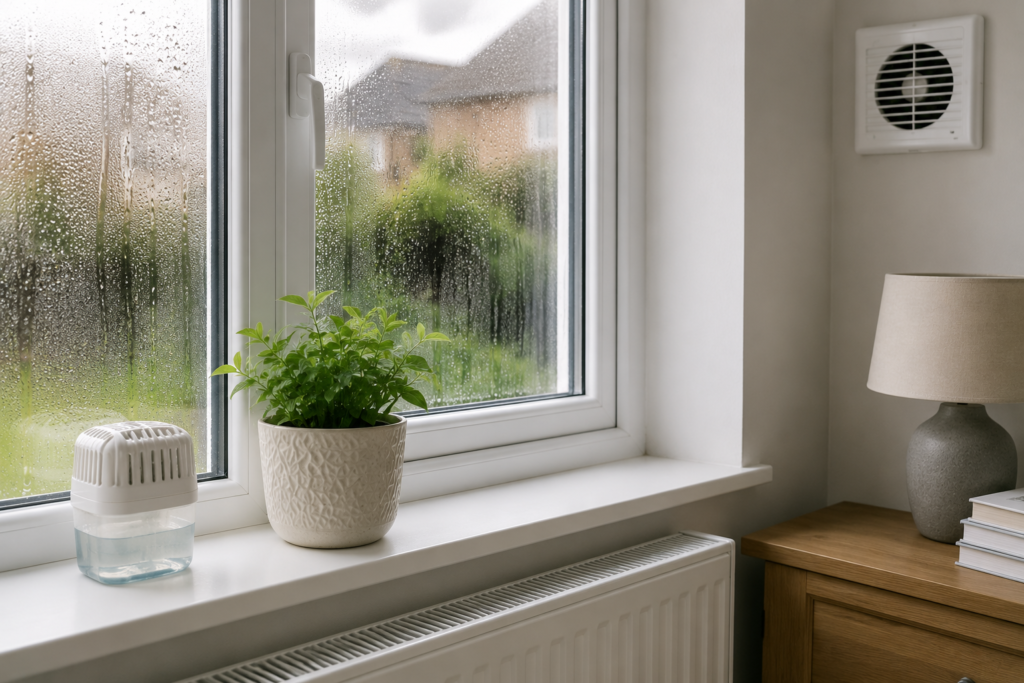
Condensation on windows happens when warm, moisture-filled indoor air meets a surface cold enough for the water vapour in that air to turn back into liquid. In UK homes, this is particularly common during autumn and winter, when the inside of the house is warm but window glass and frames can be much colder.
A small amount of condensation occasionally is not unusual. The problem starts when windows are wet most mornings, water runs onto the sill, mould begins to form around the frames, or several rooms regularly feel damp.
The most effective way to stop window condensation is usually not one single product. You need to deal with the balance between indoor humidity, ventilation, heating and cold surfaces.
For most homes, the practical approach is:
- reduce unnecessary moisture entering the air
- use ventilation properly where moisture is produced
- keep rooms reasonably and consistently warm
- allow air to circulate around windows
- remove heavy condensation before it sits on frames and seals
- use a dehumidifier where humidity remains consistently high despite sensible ventilation
This guide takes you through that process in the order that makes the most sense for a beginner. It also explains how to tell normal surface condensation from problems that need a different repair.
If you mainly notice soaked windows when you wake up, Why Do My Windows Get Condensation Every Morning? explains why bedrooms are particularly prone to overnight condensation and what the morning pattern tells you about humidity in the room.
Most Common Causes
Window condensation is a symptom rather than a fault in itself. Understanding what is causing it makes the solution much easier.
Too Much Moisture in the Indoor Air
Normal household activities release a surprising amount of water vapour.
Common sources include:
- showers and baths
- cooking and boiling water
- drying clothes indoors
- breathing while sleeping
- wet coats and towels drying inside
- large numbers of houseplants
- poorly vented tumble drying
- moisture moving from bathrooms and kitchens into other rooms
When that moisture cannot escape, relative humidity rises.
The higher the humidity, the easier it becomes for condensation to form on a cold window.
This is why two identical windows can behave differently in different rooms. A bedroom occupied overnight or a kitchen during cooking can contain far more moisture than a rarely used room elsewhere in the house.
If humidity appears high throughout the property rather than around one particular window, How to Reduce Humidity in a House Naturally covers the practical changes that reduce moisture without simply opening every window all day.
Poor Ventilation
Modern homes are generally more airtight than older properties, which is good for energy efficiency but means moisture needs a controlled route out.
Problems occur when:
- bathroom fans are weak or rarely used
- kitchen extraction is not venting moisture effectively
- trickle vents are permanently closed
- rooms remain shut for long periods
- moisture is allowed to spread from one room to another
Ventilation should remove humid air without turning the house into a permanently cold, draughty space.
This is an important distinction. Why Sealing Draughts Can Reduce Condensation explains why uncontrolled air leakage and proper ventilation are not the same thing, and why fixing a cold draught does not automatically mean making condensation worse.
Window Glass Is Very Cold
Condensation depends on both humidity and surface temperature.
Even a room with fairly normal humidity can develop condensation if the glass is extremely cold.
This can happen with:
- older glazing
- poorly performing double glazing
- very cold external temperatures
- windows in unheated rooms
- large glazed areas
- cold frames and reveals
Improving ventilation can help, but if the surface itself remains very cold you may still see some condensation during severe weather.
The Room Is Allowed to Get Too Cold
Letting a room become very cold overnight lowers the temperature of the glass, frame and surrounding walls.
When the room warms again, humid air reaches those still-cold surfaces and condensation can form quickly.
This is particularly common in:
- bedrooms
- spare rooms
- conservatory-adjacent rooms
- home offices used only during the day
A reasonably steady temperature usually performs better than large swings between very cold and very warm.
Curtains or Blinds Are Trapping Moist Air
Heavy curtains and tightly fitted blinds can create a colder pocket of air beside the window.
The main room may feel comfortable while the glass behind the curtain becomes substantially colder.
Condensation then develops overnight because moisture cannot disperse easily.
You do not necessarily need to remove curtains or blinds, but allowing some air circulation around the glass can make a noticeable difference.
Indoor Clothes Drying
Drying washing indoors is one of the biggest contributors to household humidity.
The water leaving those clothes has to go somewhere. Without strong extraction or active moisture removal, much of it enters the room air.
A drying rack placed in a bedroom or living room can therefore create condensation on windows elsewhere in the house.
Bedroom Moisture Overnight
Bedrooms are particularly difficult because occupants release moisture continuously while sleeping while doors and windows are often closed.
That is why bedroom windows can be wet every morning even if they looked completely dry before bedtime.
If condensation also appears directly on painted bedroom walls, How to Stop Condensation on Bedroom Walls covers that colder-surface problem in more detail.
Quick Diagnosis Guide
Before changing anything, work out which pattern best matches your home.
| What You Notice | Most Likely Explanation | Best First Action |
|---|---|---|
| Windows wet mainly first thing in the morning | Overnight bedroom humidity | Improve overnight ventilation and morning moisture removal |
| Several windows wet throughout the house | Overall humidity too high | Reduce moisture sources and check ventilation |
| Bathroom window streams after showers | Extraction is not keeping up | Improve bathroom extraction |
| Kitchen windows steam heavily while cooking | Cooking moisture | Use extraction and lids while cooking |
| Only one window is affected | Local temperature, ventilation or window issue | Compare the affected window with others |
| Condensation is between the panes | Sealed glazing unit problem | Window repair rather than humidity control |
| Black mould is forming around frames | Repeated surface condensation | Clean mould and solve the moisture problem |
| Walls near windows are also mouldy | Cold surfaces plus humidity | Address humidity, heating and airflow together |
Is the Condensation Inside the Room or Between the Glass?
This distinction is important.
Condensation that you can wipe from the room-facing surface of the glass is usually an indoor humidity issue.
Moisture trapped between the panes of double glazing is different. It normally indicates that the sealed glazing unit has failed. Ventilating the room or buying a dehumidifier will not repair the failed seal.
Is Occasional Condensation Normal?
A small amount can be.
For example, you may see some temporary condensation after:
- a long shower
- cooking a large meal
- an unusually cold night
- several people sleeping in a small room
What matters is frequency and severity.
If windows are soaked every morning, water is pooling on sills or mould is developing, the moisture level should be addressed.
If you are concerned about whether repeated window moisture can damage the home or affect mould growth, Is Window Condensation Dangerous? explains the difference between occasional condensation and persistent moisture problems.
Step-by-Step Solutions
Step 1: Remove Existing Condensation
Start by dealing with the water that is already present.
Wipe the glass, frame and sill with an absorbent cloth, or use a suitable window vacuum if condensation is heavy.
Do not leave pools of water sitting:
- against silicone
- in frame corners
- on timber window boards
- around rubber seals
- against painted reveals
Removing water does not solve the cause, but it prevents the condensation from repeatedly soaking nearby surfaces while you make the wider changes.
Step 2: Check How Humid the House Actually Is
A small digital hygrometer is one of the most useful inexpensive tools for a condensation problem.
It allows you to see whether humidity rises:
- overnight
- during cooking
- after showers
- while laundry is drying
- when several people are at home
Do not obsess over a single percentage reading because relative humidity changes with temperature.
Instead, look for patterns.
If humidity rises sharply after normal household activities and stays elevated for hours, moisture is not being removed quickly enough.
Step 3: Use Bathroom Extraction Properly
Bathrooms create large amounts of moisture very quickly.
Use the extractor while showering or bathing and allow it to continue running afterwards where the fan setup allows.
Keep the bathroom door closed while the room is steamy so the moisture does not simply migrate into bedrooms and hallways.
If the bathroom itself remains damp for long periods, the problem may be the extraction rather than the windows. How to Choose the Right Bathroom Ventilation Fan (UK Guide) explains what matters when assessing or replacing a bathroom fan.
Persistent bathroom moisture can eventually appear elsewhere too. Why Your Bathroom Ceiling Gets Mouldy (And How to Stop It) is useful where condensation has already started creating mould above the shower or bath.
Step 4: Control Moisture While Cooking
Use kitchen extraction while:
- boiling pans
- steaming food
- using several hob rings
- cooking for long periods
Use saucepan lids where practical.
A large amount of cooking moisture can quickly raise humidity throughout an open-plan area and eventually affect windows in adjacent rooms.
Step 5: Change How You Dry Clothes Indoors
Where possible, dry washing outdoors or use an appropriately vented or moisture-controlled appliance.
If you must use an indoor drying rack:
- keep it out of bedrooms if possible
- use a room with suitable ventilation
- close the room off from the rest of the house
- consider active moisture removal if large loads are frequently dried indoors
Simply opening doors throughout the house spreads the moisture rather than removing it.
Step 6: Use Trickle Vents and Background Ventilation
If your windows have trickle vents, they are designed to provide a small amount of controlled background ventilation.
Keeping them permanently closed can allow humidity to build overnight.
Do not confuse this with leaving a large window fully open during freezing weather. The aim is steady moisture removal without excessive heat loss.
Step 7: Air Bedrooms After Sleeping
Bedrooms can accumulate significant moisture overnight.
In the morning:
- open curtains or blinds
- allow air to circulate around the window
- use appropriate ventilation
- wipe heavy condensation away
- avoid immediately trapping damp air behind closed curtains
This simple routine can dramatically reduce how long window areas remain wet.
Step 8: Improve Air Circulation Around Cold Surfaces
Avoid creating sealed pockets of stagnant air.
Check whether:
- blinds sit tightly against the glass
- curtains completely cover the window recess
- large furniture blocks radiators
- furniture is pressed against cold external walls
The aim is not to create a strong draught. You simply want normal room air to reach cold surfaces instead of moisture becoming trapped beside them.
Step 9: Heat the Home More Consistently
Heating does not remove water vapour by itself, but it raises surface temperatures and lowers relative humidity for a given amount of moisture.
Very cold rooms are therefore more prone to condensation.
You do not need to overheat the house. A more consistent comfortable temperature is usually more useful than allowing rooms to become extremely cold and then heating them briefly.
Step 10: Check for Mould Around the Window
If condensation has been present for a while, inspect:
- rubber seals
- lower frame corners
- silicone joints
- the edge of the plaster reveal
- behind blinds and curtains
Small black spots should not simply be painted over.
How to Stop Black Mould Around Window Frames (UK Guide) explains how to deal with recurring mould while also correcting the condensation conditions that caused it.
For suitable washable window-frame surfaces, Best Mould Remover Spray for Window Frames (UK) explains which types of mould treatment are most useful and where stronger cleaning products may be unnecessary.
Step 11: Check Whether the Problem Is Actually a Leak
Condensation usually appears on cold surfaces in a fairly predictable pattern.
Investigate more carefully if you see:
- one isolated damp patch
- brown or yellow staining
- plaster that remains wet
- damage that worsens after rain
- moisture appearing when indoor humidity is otherwise normal
In that situation, How to Tell If Mould Is Caused by Condensation or a Leak helps distinguish normal surface moisture from water entering the building.
Step 12: Consider a Dehumidifier When the Basics Are Not Enough
A dehumidifier can be extremely useful where humidity remains high despite reasonable ventilation and moisture control.
It is particularly helpful when:
- washing has to be dried indoors regularly
- the property is difficult to ventilate
- several rooms remain humid
- condensation is severe during winter
- moisture levels rise faster than ventilation can remove them
A dehumidifier is not a substitute for fixing leaks or broken extraction, but it can be an effective part of the overall solution.
Best Dehumidifier for Condensation in UK Homes covers the practical buying considerations if you decide one would help.
If you are unsure whether active moisture removal is actually necessary, Do Dehumidifiers Really Stop Mould? explains what dehumidifiers can and cannot achieve.
For homes where the real choice is between improving extraction and buying a dehumidifier, Dehumidifier vs Ventilation Fan – Which Is Better? explains when each approach makes more sense.
Tools That Can Help
You do not need a cupboard full of specialist equipment to deal with window condensation.
A few well-chosen tools can make diagnosis and control much easier.
Hygrometer
A digital hygrometer helps you see whether condensation coincides with high indoor humidity.
It is especially useful for comparing:
- bedrooms
- bathrooms
- kitchens
- upstairs and downstairs rooms
The value is in spotting patterns rather than chasing a perfect number.
Window Vacuum or Absorbent Cloth
For homes with heavy morning condensation, removing the existing water quickly protects:
- window frames
- seals
- sills
- surrounding paint
- nearby plaster
This is moisture management rather than a cure, but it is still worthwhile.
Dehumidifier
A dehumidifier actively removes water from the indoor air and can be extremely effective in persistent high-humidity homes.
It is most useful when the source of moisture cannot easily be eliminated completely.
Extractor Fans
Good bathroom and kitchen extraction removes moisture close to where it is produced.
That is usually more efficient than allowing humid air to spread throughout the home and trying to deal with it afterwards.
Suitable Mould Cleaner
Where condensation has already produced surface mould, a suitable cleaner can remove the visible growth.
However, mould treatment should always be accompanied by moisture control. Otherwise the same patch is likely to return.
When to Call a Professional
Most window condensation problems are suitable for household management, but there are situations where another fault needs investigation.
Condensation Between Double-Glazed Panes
If moisture is trapped inside the sealed glazing unit, the unit itself may have failed.
That is not something ventilation will solve.
Persistent Damp Around One Window
A single repeatedly wet area may indicate:
- failed external sealant
- damaged render
- water ingress
- a window installation problem
Plaster Is Soft, Crumbling or Heavily Stained
This suggests more than occasional surface condensation and warrants investigation before simply cleaning or redecorating.
Mould Persists Despite Good Humidity Control
If you have genuinely reduced moisture, improved ventilation, maintained sensible heating and still have a concentrated recurring damp patch, another source may be involved.
The Window or Frame Is in Poor Condition
Damaged frames, failed seals or installation gaps can create exceptionally cold areas and water-entry routes.
The key is not to assume every wet window requires professional work. Most do not. But persistent local damage that does not respond to sensible condensation control should not be ignored.
How to Stop Condensation Coming Back Long Term
The most successful approach is usually a combination rather than one dramatic change.
For most homes:
- use extraction every time moisture is produced
- keep trickle vents functioning where fitted
- remove heavy morning condensation
- avoid drying large quantities of washing in unventilated rooms
- maintain sensible room temperatures
- allow airflow around glazing and external walls
- monitor humidity if the problem is persistent
- use a dehumidifier where the moisture load genuinely requires one
- investigate isolated damp patches rather than assuming everything is condensation
It can take a little experimentation to identify the biggest contributor in your particular home. Once you find it, however, the improvement is usually obvious: less water on the glass, drier window frames, fewer musty areas and a lower chance of mould returning.
Related Fix Guides
- Why Do My Windows Get Condensation Every Morning?
- Is Window Condensation Dangerous?
- How to Tell If Mould Is Caused by Condensation or a Leak
- How to Stop Condensation on Bedroom Walls
- How to Reduce Humidity in a House Naturally
- How to Stop Black Mould Around Window Frames (UK Guide)
- Do Dehumidifiers Really Stop Mould?
- Best Dehumidifier for Condensation in UK Homes
- Dehumidifier vs Ventilation Fan – Which Is Better?
- Why Sealing Draughts Can Reduce Condensation