Introduction
A socket tester is one of the few electrical tools that can be genuinely useful for ordinary homeowners without crossing into unsafe DIY territory. Used properly, it gives you a quick way to check whether a socket appears to be wired correctly and whether certain obvious faults may be present before you plug valuable equipment in or before you decide a socket needs closer attention.
That said, a socket tester is also one of the easiest electrical products to misunderstand. It does not make you an electrician. It does not prove every part of a circuit is safe. And it does not give you permission to open sockets, remove faceplates or start fixing electrical faults yourself. What it can do is give you a quick, simple first check that helps you spot warning signs and decide whether to stop using a socket and move to the next safe step.
This guide explains the best socket testers in the UK, what features actually matter, and what a homeowner should and should not expect from one. Because misuse and overconfidence are the biggest risks in this category, this article includes a “what a socket tester can and cannot tell you” section before the buying advice.
If you are dealing with a wider electrical fault rather than just shopping for a tester, Common Electrical Problems in UK Homes (Safe Checks Guide) is the main hub for this cluster. And if the real issue is an actual dead or suspect outlet, What to Do If a Plug Socket Stops Working is the best first article to read before you start testing.
Quick Recommendation
For most UK homeowners, the best choice is a simple plug-in socket tester with clear indicator lights, an easy-to-understand fault legend and an RCD test button where appropriate.
That is usually the right balance because it gives you:
- a quick first check without complexity
- clear visual feedback
- enough function for common domestic use
- a simple way to screen obvious socket issues
- a safer and more realistic homeowner tool than anything more advanced and technical
For most homes, the best socket tester is not the one with the most features. It is the one that is easiest to use correctly and hardest to misread.
Product Comparison Table
| Product Type | Best For | Main Strength | Main Weakness | Best Buy For |
|---|---|---|---|---|
| Basic Plug-In Socket Tester | Simple household checks | Very easy to use | Limited depth of diagnosis | Most homeowners |
| Socket Tester with RCD Test Button | Homes wanting an extra basic RCD check function | More useful for screening protection behaviour | Still not a substitute for proper fault diagnosis | General domestic use |
| Tester with Clear Printed Fault Legend | Beginners wanting lower confusion risk | Easier interpretation | Usually little functional difference from other simple testers | First-time buyers |
| Branded Mid-Range Socket Tester | Regular household maintenance use | Usually better build quality and clearer instructions | Costs more than basic testers | Homeowners wanting a better long-term tool |
| Multi-Function Electrical Tester | More experienced users | Broader capability | Often overkill and easier to misuse for general homeowners | Not the best default choice for casual domestic checks |
Best Options Explained
Basic Plug-In Socket Testers
This is the category most households should start with.
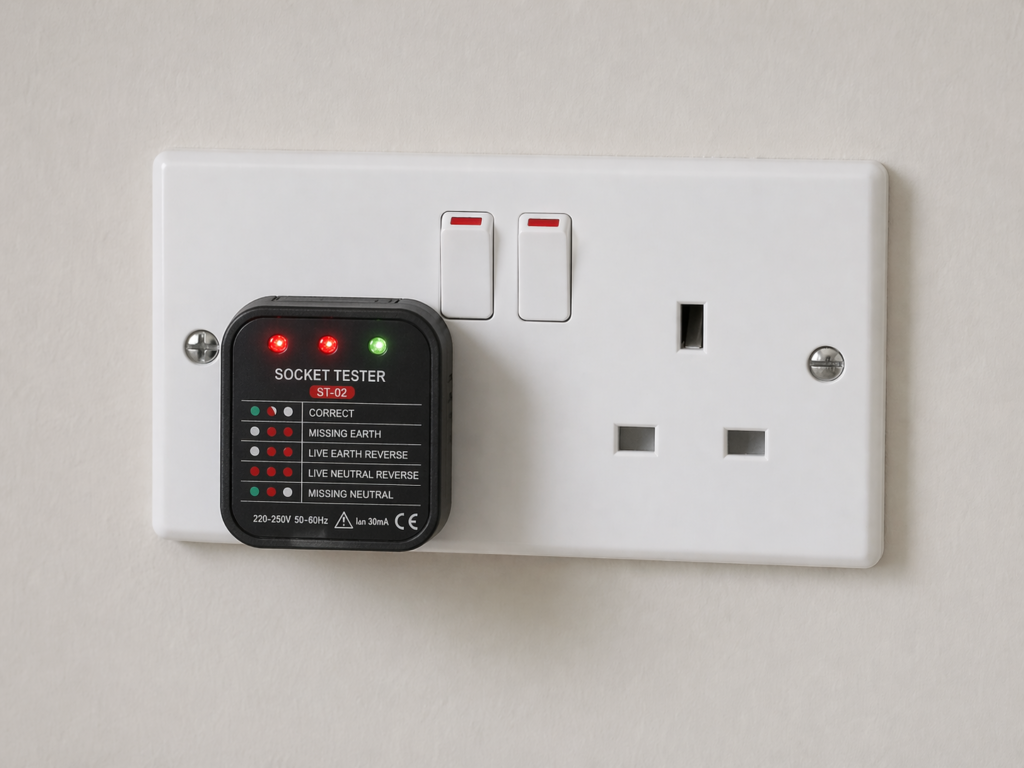
A basic socket tester plugs directly into the socket and uses a simple pattern of lights to indicate whether the wiring appears normal or whether a likely fault is present. For ordinary domestic use, this is often enough.
It is a good choice when:
- you want to check a suspect socket quickly
- you have moved house and want a simple first check on outlets
- you want a basic screening tool without complexity
- you are trying to decide whether a socket should be left alone and assessed properly
For many homeowners, this is the best value and most sensible option. Simplicity is a benefit in this category, not a weakness.
Socket Testers with an RCD Test Button
These are often the best all-round option for homeowners because they add a little more practical usefulness without becoming complicated.
The RCD test function can help with basic screening where appropriate, especially if you are checking socket circuits and want an additional simple indication that the protective device responds. But this needs to be understood correctly: it is still only a basic test, not a full electrical safety assessment.
This type suits:
- homes where you want a bit more than just wiring light patterns
- buyers who want a more useful all-purpose domestic tester
- homeowners taking electrical safety seriously without overreaching
If your concern is already centred on tripping devices, What to Do If Your Fuse Box Trips (RCD/MCB) (UK) and How to Reset a Tripped RCD Safely (UK) are the more relevant supporting guides.
Testers with Clear Fault Legends
In this product category, clarity matters more than styling. A tester that clearly explains what each light pattern means is often a better choice for a beginner than one with a vague or confusing legend.
This is especially useful if:
- you have never used a socket tester before
- you want to minimise interpretation mistakes
- you are buying for family use, not just your own
Better Branded Mid-Range Testers
A slightly better-made tester can be worth it if you expect to use it more than once in a blue moon. Better build quality, clearer moulding, more legible instructions and a more dependable feel are all real benefits in electrical safety tools.
How to Choose the Right Option
Keep the Intended Use in Mind
The right question is not “what is the most advanced tester?” It is “what is the safest and most useful tester for a homeowner doing basic checks?”
For most people, the answer is a straightforward plug-in tester with very clear indications.
Prioritise Clarity Over Complexity
A simple tester with unambiguous lights and instructions is far more useful than a more complex unit you are not fully confident using.
Choose Real Domestic Usefulness
A socket tester should help with practical questions like:
- does this socket appear normal?
- should I stop using this outlet?
- is this enough of a warning sign that I need an electrician?
It does not need to become a pseudo-professional instrument to be useful.
What a Socket Tester Can and Cannot Tell You
Before buying, it helps to be realistic about the product.
What it can do
- provide a quick first check on many common 13A socket outlets
- indicate certain obvious wiring issues
- help identify that something may be wrong
- help you decide when to stop using a socket and move to the next safe step
What it cannot do
- prove a whole circuit is safe
- replace proper electrical inspection and testing
- justify opening sockets or fixing wiring yourself
- diagnose every electrical fault
- tell you everything about load, condition or long-term safety
This is one of the most important sections in the whole article. A good socket tester is useful. A misunderstood socket tester is risky.
What Makes a Good Socket Tester?
Clear Indicator Lights
You should be able to read and interpret it quickly without second-guessing what the result means.
Clear Fault Legend
The easier the legend is to understand, the more useful the tester is in real life.
Solid Construction
A tester should feel properly made and not flimsy, especially for a tool used around mains sockets.
Sensible Features Only
A basic RCD test button is often worthwhile. Beyond that, many homeowners do not need complexity.
Common Buying Mistakes
Buying the Most Complicated Tester You Can Find
For most homeowners, that is unnecessary and often less safe in practice because it invites overconfidence.
Treating a Socket Tester Like a Full Safety Certificate
It is not. It is a quick screening tool, not a complete electrical diagnosis.
Using a Tester but Ignoring Other Warning Signs
A socket that feels hot, smells burnt, crackles or is physically damaged should not be treated casually just because a tester result seems reassuring.
Assuming a “Normal” Reading Means There Is Definitely No Problem
Socket testers are useful, but they have limits. If the symptoms are serious, trust the symptoms.
When You May Not Need This Product
You may not need to buy a socket tester if:
- the socket is visibly damaged and already clearly needs professional attention
- the problem is a repeated tripping issue affecting a circuit, not one outlet
- the fault is obvious enough that the safe choice is simply to stop using the socket
- you are likely to use it once and then never again
If the main concern is general electrical safety around extension use rather than outlet testing, Best Extension Leads (UK) (Safety-first) and Is It Safe to Use an Extension Lead Permanently? may be more relevant. And if your actual issue is that a socket feels loose or unsafe physically, Why a Plug Socket Feels Loose (And What You Can Do Safely) is a better next read than product shopping alone.
Related Fix Guides
- Common Electrical Problems in UK Homes (Safe Checks Guide)
- What to Do If a Plug Socket Stops Working
- What to Do If Your Fuse Box Trips (RCD/MCB) (UK)
- How to Reset a Tripped RCD Safely (UK)
- Why a Plug Socket Feels Loose (And What You Can Do Safely)
- When to Call an Electrician (Red Flags)