Introduction
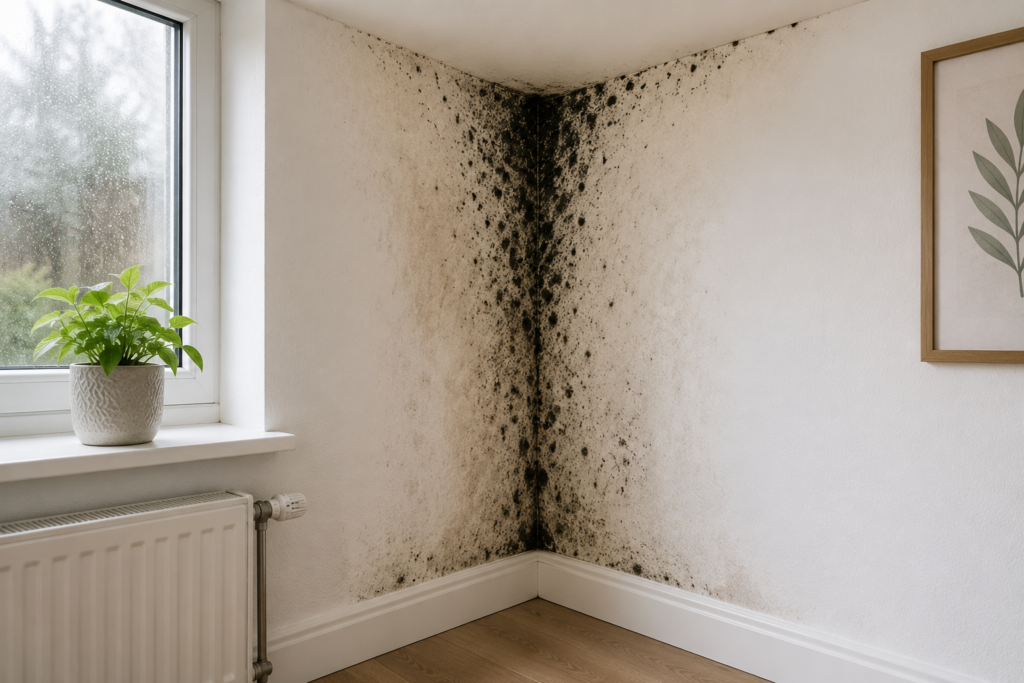
Black mould in the corners of rooms is most often caused by a combination of high indoor humidity, cold wall surfaces and poor airflow.
Corners are particularly vulnerable because they are often colder than the main face of the wall. Where two external walls meet, or where an external wall meets a ceiling, heat can escape more quickly through the building fabric. If humid indoor air repeatedly reaches that colder surface, small amounts of condensation can form even when you never see visible water droplets.
That moisture can then remain trapped for longer because corners receive less air movement than open wall surfaces. Put a wardrobe, bed, sofa or heavy curtain close to the area and the conditions become even better for mould growth.
In many UK homes, this is a condensation problem rather than a serious defect. However, black mould in one very specific corner can also be caused by a leak, damaged guttering, failed external pointing or another source of water ingress. The pattern of the mould, when it appears and what the wall feels like are important clues.
This guide explains what causes black mould in corners of rooms, how to identify the most likely cause, what you can do to stop it returning, and which warning signs suggest the problem needs further investigation.
For the wider moisture-control picture, How to Stop Condensation on Windows is the main FixItSimple hub covering condensation, humidity and mould problems throughout the home.
Why This Happens
Mould needs moisture to grow. The reason room corners are such common mould locations is that several moisture-related factors often come together in exactly the same place.
1. The corner is colder than the rest of the wall
This is usually the biggest reason.
A wall does not have exactly the same surface temperature everywhere. Corners, wall-to-ceiling junctions and areas around structural elements can be noticeably colder than the middle of a wall.
Where two external walls meet, heat can flow through more building material at once. This effect is often described as a thermal bridge or cold bridge.
You do not need a dramatic construction fault for this to happen. Even in an otherwise sound home, the internal surface temperature of an external corner can be lower than the surrounding wall.
When warm room air reaches that colder surface, the air immediately beside it cools. Cooler air cannot hold as much water vapour, so moisture begins to collect on the surface.
Sometimes this creates visible droplets. More often, the surface is simply damp enough for long enough to support mould.
2. Indoor humidity is too high
A cold corner alone does not guarantee mould. There also needs to be enough moisture in the room air.
Everyday activities add moisture to a home, including:
- showering
- bathing
- cooking
- drying clothes indoors
- breathing overnight
- using unvented drying racks
- allowing bathroom steam to move into bedrooms and hallways
If the humidity is already high, condensation can form on a wall at a much higher surface temperature than it would in a drier room.
This is why corner mould often appears alongside:
- wet windows in the morning
- mould around window frames
- damp bedroom walls
- condensation behind curtains
- stale or stuffy air
If those symptoms are common throughout the house, How to Reduce Humidity in a House Naturally is the most useful supporting guide because the problem is probably bigger than one isolated corner.
3. Air cannot circulate properly
Corners naturally receive less airflow than the middle of a room.
That becomes much worse when furniture or furnishings block the area.
Common examples include:
- wardrobes pushed tightly against external walls
- beds positioned directly in corners
- sofas against cold walls
- storage boxes stacked against skirting
- heavy curtains covering a corner
- fitted furniture with almost no ventilation behind it
The wall behind the object remains colder because warm room air cannot reach it properly. Any moisture that does form also evaporates more slowly.
This is why you can sometimes move a wardrobe and discover a much larger mould patch behind it than was visible from the room.
4. The room is allowed to become very cold
Bedrooms, spare rooms and home offices are common problem areas because they are often heated less consistently than the rest of the house.
If a room becomes very cold overnight or is left unheated for long periods, its external walls cool considerably.
Then, when warm humid air reaches the room from elsewhere in the house, condensation can form quickly on the coldest surfaces.
A more consistent moderate room temperature is usually better for condensation control than repeatedly allowing the room to become very cold and then heating it sharply for a short period.
5. There may be a leak or building defect
Condensation is the most common explanation, but it is not the only one.
Water can enter a corner because of:
- overflowing or leaking guttering
- damaged roof coverings
- failed pointing or render
- cracks around external openings
- leaking plumbing
- defective seals around a nearby window
- roof-to-wall junction problems
This type of mould often behaves differently from normal condensation mould.
If the patch stays damp regardless of ventilation and room temperature, or becomes worse after rainfall, treat that as a clue that the moisture may be entering from somewhere else.
Quick Cause Ranking: What Is Most Likely?
Use this as a practical starting point.
| Likely Cause | Typical Signs | How Common? |
|---|---|---|
| Cold external corner / thermal bridging | Mould in upper or lower corner, worse in winter | Very common |
| High indoor humidity | Wet windows, mould elsewhere, stuffy rooms | Very common |
| Poor airflow behind furniture | Mould strongest behind wardrobe, bed or sofa | Very common |
| Room kept too cold | Problem in spare rooms or colder bedrooms | Common |
| Leak or external water ingress | Local staining, persistent wetness, worsens after rain | Less common but important |
In many homes, the first three happen together rather than separately.
Tools or Materials You May Need
You do not need specialist diagnostic equipment for the first checks.
Useful items include:
- hygrometer
- torch
- rubber or nitrile gloves
- suitable mould remover
- microfibre or disposable cloths
- phone camera for monitoring the area
- dehumidifier if persistently high humidity is confirmed
If you need to treat existing surface mould, Best Mould Remover Spray for Window Frames (UK) is relevant for suitable washable surfaces, although you should always check that the chosen product is appropriate for the wall finish you are treating.
If humidity remains high despite normal ventilation and moisture-control measures, Best Dehumidifier for Condensation in UK Homes explains what to look for before buying a unit.
Step-by-Step Fix
Step 1: Identify whether the corner is on an external wall
Start with the simplest clue.
If the mould is where:
- two external walls meet
- an external wall meets the ceiling
- a cold outside-facing wall meets another wall
condensation becomes a strong possibility.
External corners are naturally more vulnerable because they tend to have lower internal surface temperatures.
An internal corner far away from any outside wall deserves a broader check, especially if plumbing passes nearby.
Step 2: Look at the pattern of the mould
Condensation mould often appears as:
- small black spots
- a speckled patch spreading outward from the corner
- mould behind furniture
- growth that is noticeably worse in winter
- repeat growth after cleaning if nothing else changes
Water ingress more often produces:
- one concentrated damp patch
- yellow or brown staining
- bubbling paint
- soft or damaged plaster
- a clear relationship with rain or plumbing use
If you are struggling to tell the difference, How to Tell If Mould Is Caused by Condensation or a Leak gives a more detailed diagnosis.
Step 3: Check for hidden mould behind furniture
Move furniture away from the wall far enough to inspect properly.
Check:
- the back of the furniture
- the skirting
- the wall surface behind it
- the floor edge
- the corner itself
If the mould is substantially worse behind the object, poor airflow is almost certainly contributing.
Do not immediately push the furniture back into the same position after cleaning. Leave a sensible airflow gap.
Step 4: Check the room humidity
A basic hygrometer is useful because it helps you understand whether the room is carrying too much moisture.
Rather than relying on one reading, watch the pattern at different times:
- first thing in the morning
- after showers
- while cooking
- while drying clothes
- during the evening
- during cold weather
If the room is consistently humid and nearby windows regularly collect condensation, the corner mould is much more likely to be condensation-driven.
Step 5: Reduce the biggest moisture sources
Focus first on activities that add large amounts of water vapour to the house.
Useful changes include:
- using bathroom extraction during and after showers
- using kitchen extraction while cooking
- keeping bathroom doors closed while the room is steamy
- avoiding drying washing in poorly ventilated bedrooms
- airing bedrooms after sleeping
- opening trickle vents where appropriate
Do not rely on leaving random draughts around the house as your ventilation strategy. Controlled ventilation is much more useful than cold air leaking through failed seals.
Step 6: Improve airflow around the affected corner
Once the corner is accessible:
- move furniture slightly away from the wall
- avoid storing boxes tightly against it
- keep heavy curtains from trapping the area permanently
- allow normal room air to reach the surface
Even a modest improvement in airflow can help a previously mould-prone wall dry more quickly.
If the problem is concentrated in a bedroom, How to Stop Condensation on Bedroom Walls covers overnight humidity, furniture positioning and cold-wall condensation in more detail.
Step 7: Avoid allowing the room to become excessively cold
You do not need high temperatures specifically to prevent mould, but very cold rooms create colder wall surfaces.
Aim for a more stable environment rather than large swings between very cold and suddenly warm.
This is particularly important in:
- spare bedrooms
- unused home offices
- bedrooms with external corners
- rooms above garages or other cold spaces
Step 8: Clean the existing mould safely
Once you have started dealing with the cause, remove the visible surface mould.
Wear gloves, ventilate the room and follow the instructions for the mould-cleaning product.
Avoid dry-brushing or sanding mouldy surfaces, which can spread spores and contamination around the room.
After cleaning, dry the surface properly.
Step 9: Monitor the area rather than immediately redecorating
Take a photograph once the area is clean.
Monitor it over the following weeks, especially during:
- cold mornings
- wet weather
- periods of high indoor humidity
If the corner stays clean after airflow and humidity improvements, that strongly supports a condensation diagnosis.
If the same small patch becomes wet again despite those changes, investigate more carefully for water ingress.
When This Is Not a DIY Fix
Most black corner mould caused by condensation can be improved through moisture control, airflow and cleaning.
However, stop treating it as a simple surface problem if you see:
- plaster becoming soft or crumbly
- persistent wetness rather than occasional condensation
- brown or yellow staining
- mould returning very quickly in exactly the same patch
- deterioration that gets worse after rainfall
- rotting or damaged timber
- a large damp area spreading beyond the corner
- no improvement despite sensible humidity and ventilation changes
These signs can point to a leak or building-fabric problem rather than routine condensation.
If the corner has progressed beyond ordinary surface mould, When Is Mould a Structural Problem? explains which warning signs justify further investigation.
How to Prevent the Problem
Once the mould is removed, prevention is about keeping the wall warmer, drier and better ventilated locally.
Control indoor humidity
Use extraction, reduce unnecessary indoor moisture and air rooms sensibly.
Keep air moving behind furniture
Do not pack large items tightly into external corners.
Avoid very cold rooms
More stable temperatures reduce the risk of the coldest wall surfaces reaching condensation conditions.
Deal with wet windows
If windows are regularly covered in condensation, remove the water rather than letting it sit on frames and nearby walls.
Fix unnecessary draughts without blocking proper ventilation
Cold uncontrolled air leakage can lower local surface temperatures, but useful ventilation should not simply be blocked. Why Sealing Draughts Can Reduce Condensation explains how to improve the balance.
Investigate unusual local dampness early
If the problem does not behave like condensation, do not spend months repeatedly cleaning it. Find out why the wall is getting wet.
Quick Checklist Summary
- Black mould in room corners is most commonly caused by condensation.
- External wall corners can be colder because of thermal bridging.
- High indoor humidity makes mould much more likely.
- Furniture and curtains can trap cold, damp air against the wall.
- Very cold bedrooms and spare rooms are particularly vulnerable.
- Move furniture away from external corners and improve airflow.
- Reduce indoor moisture and use existing ventilation properly.
- Clean existing mould only after starting to address the cause.
- Persistent staining, soft plaster or rain-related dampness needs further investigation.
Related Guides
- How to Stop Condensation on Windows
- How to Tell If Mould Is Caused by Condensation or a Leak
- How to Stop Condensation on Bedroom Walls
- How to Reduce Humidity in a House Naturally
- When Is Mould a Structural Problem?
- Best Dehumidifier for Condensation in UK Homes
- Why Sealing Draughts Can Reduce Condensation